Guide 01 · Start here
How to read a Yupoo album: a sequence, not a shop
Yupoo albums were built for sharing photos, and shops were bolted on afterwards. That origin explains the format: three page layers, one product page that matters, and a frame order that repeats on almost every listing — which is exactly what makes it readable.
The three layers
Where you are, and what it can tell you
Most confusion about Yupoo comes from judging the wrong layer. The storefront looks professional and tells you nothing. The product page looks plain and tells you everything. Knowing which page you are on prevents most bad decisions before they become orders.
- 01
The album index
The storefront page. It lists albums or categories with a cover image each. Everything here is navigation, so the only thing worth judging is whether the taxonomy makes sense for what you want to buy.
- 02
The category tree
Inside an album, products are grouped by category codes — often numeric, sometimes named. A good tree lets you reach a specific object in two clicks. A bad one is a flat list of everything.
- 03
The product page
The only page that matters. It holds the frame sequence, sometimes a size chart image, and a caption. This is where evidence either exists or does not.
The six frames
What a product page usually contains, in order
The sequence below repeats across sellers because it repeats across the upload tools. Once you know it, a missing frame is as informative as a present one.
- 01
Cover
Usually a studio shot on white, often the strongest composition. It is advertising and should be treated as such — nothing on this frame is evidence of the specific unit.
Ask Nothing yet.
- 02
Three-quarter
The most useful frame on most listings. Angles expose proportions: heel height, shoulder drop, hood volume. If this frame is missing, the album is hiding the silhouette.
Ask Is the angle the same as the retail photo?
- 03
Detail
A close crop of stitching, print or hardware. The honest version is shot at 100% with raking light; the dishonest version is a wide crop passed off as detail.
Ask Is this a crop of the actual product or a retail press image?
- 04
Label or marking
Inside label, sole stamp, clasp engraving. Markings are the easiest thing to fabricate, so they prove intent to show you something — not that the marking is correct.
Ask Is the label legible at full size, or blurred on purpose?
- 05
Measurement
A tape measure on the garment or a size chart image. Most albums stop before this frame. When it is present, it is the single most valuable frame in the sequence.
Ask Are the numbers consistent between sizes?
- 06
Packaging
Boxes, dust bags, tissue. Pure theatre: it photographs well and tells you nothing about the item. Treat a packaging-heavy album as a warning that frames 2 to 5 may be thin.
Ask Why is packaging shot before measurements?
A real sequence
Read this listing with me
These are the opening frames of one listing from the promoted catalogue — Dior 30 Montaigne Mini White Structured Chain Bag. Notice what the early frames do and do not prove.
 Frame 01
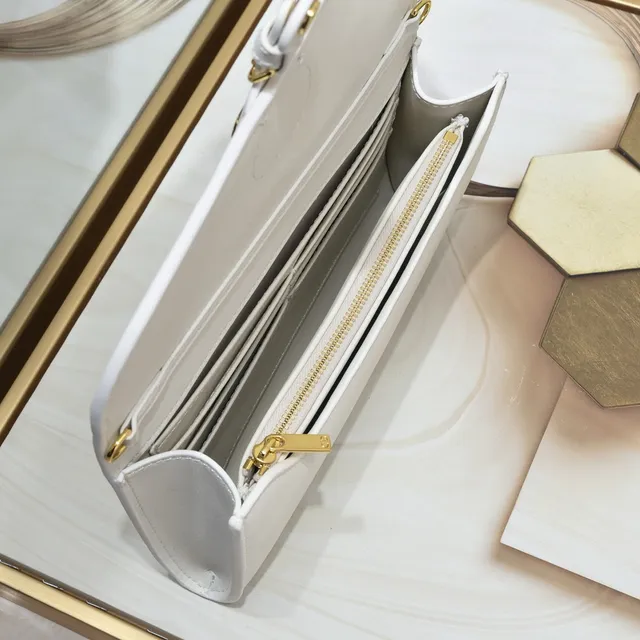 Frame 02
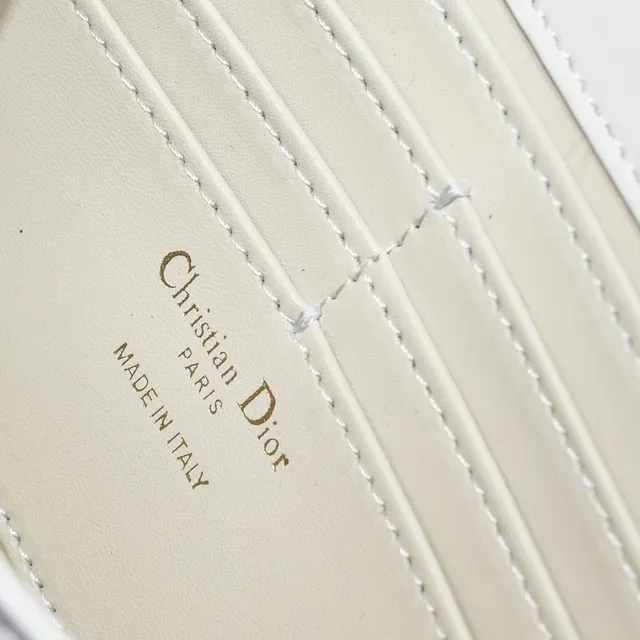 Frame 03
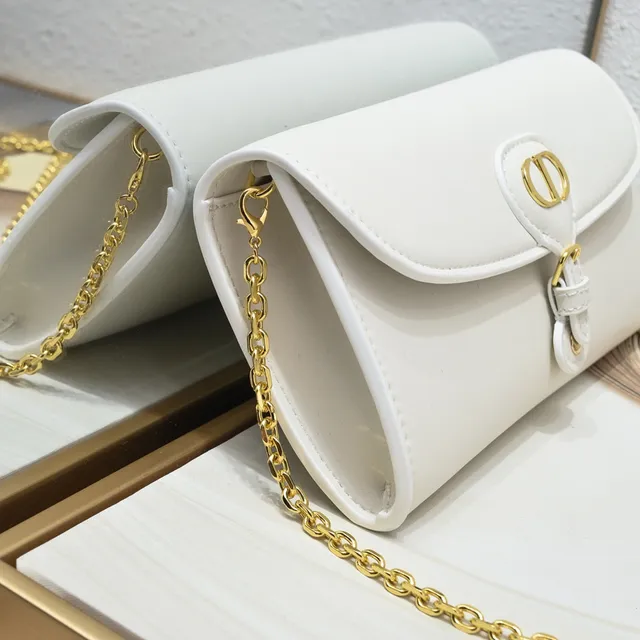 Frame 04
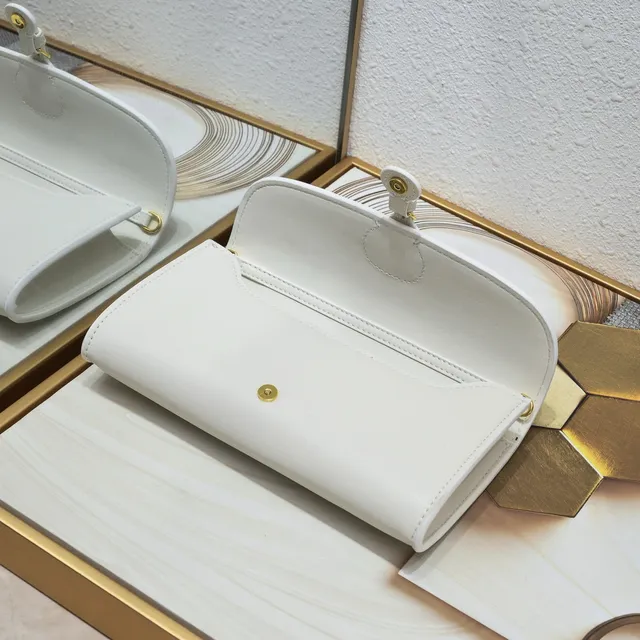 Frame 05
 Frame 06
Frames belong to WWTop Yupoo. This is a sample of the sequence, not a stock guarantee — check the live listing before ordering.
The ten-second test
Four comparisons that separate evidence from styling
| What you see | What it means | What you see instead | What that means |
|---|---|---|---|
| Frame 2 present at a true angle | Proportions are being shown on purpose | Only frame 1 and 6 are sharp | Composition is the priority, not the object |
| Frame 5 carries a tape measure | The seller expects a measurement question | Size chart is a screenshot from another brand | Sizing will be guesswork |
| Detail crops are sharp at 100% | You can actually check stitching | Every detail is soft-focus | Nothing is checkable |
| Caption names the batch or album code | Traceability exists | Caption is a keyword list | Listing is written for search, not buyers |
A listing that passes all four has nothing left to hide in the frames. What remains unknown is the unit itself, which is what QC photos exist for.
A readable listing looks like
- Every frame is a real photo of the same product
- At least one measurement frame with a tape visible
- Detail crop that survives being opened at full size
- Caption naming the album code or batch
- No frame repeated in two listings
An unreadable listing looks like
- Retail press images mixed in with own photos
- Measurements missing, replaced by “size M/L/XL”
- Every detail frame slightly soft
- Caption is a keyword string, sometimes in another language
- Same cover image on five different products
Sources
Sources and further reading
These are the primary sources behind the claims about customs, consumer rights and complaints. They are independent of this site and of the promoted catalogue.
| Reference | Publisher | Why it is here |
|---|---|---|
| Consumer protection rights (opens GOV.UK in a new tab) | GOV.UK | The UK baseline for refunds, faulty goods and chargebacks — useful when deciding whether a dispute is worth opening. |
| Where to file a consumer complaint (opens USA.gov in a new tab) | USA.gov | The federal directory of complaint routes, including the agencies that handle cross-border purchases. |
FAQ
Album questions
Is a longer gallery always better?
No. Six informative frames beat twenty styling frames. Count the frames that carry measurements or 100% detail, not the total.
Can I trust a seller because the album loads fast?
Page speed says something about the album host, not about the goods. Plenty of well-built albums are hosted by sellers whose stock is inconsistent.
What if the listing shows no measurement frame at all?
Assume nothing is measured and ask directly for the five flat numbers. If the answer is a size letter instead of numbers, treat that as a no.
Does the frame order ever change?
Rarely. Sequence is habit: sellers upload in the same order every time, which is why a missing frame 5 is conspicuous.
Where do QC photos fit in?
They are not part of the album. Album frames are the seller’s marketing; QC photos are taken of your unit in a warehouse. Read the QC guide next for that sequence.
Where this leaves you
You now have a reading order: layer, then frame, then question. The next guide turns the measurement frame into something usable — the five flat numbers that make a size letter irrelevant. If you would rather see the short version first, the method page compresses all five guides into one page.
One caution before you continue: a readable listing is not a recommendation. It means the seller gave you enough to judge. What you judge is still up to you, and the price is still not in the album.